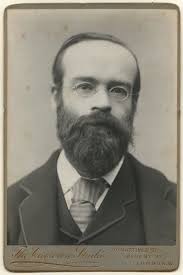
 Sir Walter Leaf (November 26, 1852 – March 8, 1927) was an English banker, classical scholar, and psychical researcher.
Queer Places:
Harrow School, 5 High St, Harrow HA1 3HP, United Kingdom
University of Cambridge, 4 Mill Ln, Cambridge CB2 1RZ
Sir Walter Leaf (November 26, 1852 – March 8, 1927) was an English banker, classical scholar, and psychical researcher.
He was born on November 26, 1852, in Upper Norwood, Surrey (now part of Greater London), into a prosperous commercial family. After attending Harrow School, he entered Trinity College, Cambridge, in 1870. A brilliant classicist, he was named Senior Classic in 1874 and elected to a Trinity fellowship in 1875.
Leaf is best remembered as one of the preeminent Homeric scholars of the late 19th and early 20th centuries. His magnum opus, a benchmark two-volume edition of The Iliad (published 1886–1888, with later revisions), stood for decades as the definitive English scholarly edition. He also co-translated The Iliad into prose with Andrew Lang and Ernest Myers (1892) and published geographical and historical studies on Troy and the ancient world.
Despite his immense academic output, Leaf spent the first portion of his working life running the family silk and textile merchant house (Leaf & Company). Transitioning full-time into finance in the late 19th century, he became a director of the London and Westminster Bank in 1891 and served as its Chairman from 1918 until his death. A key figure in British economic recovery following World War I, he helped found the International Chamber of Commerce (serving as its president) and acted as president of the Institute of Bankers. In addition, he was deeply interested in psychical research and served on the council of the Society for Psychical Research.
During his undergraduate years at Trinity College, Cambridge, Leaf was inducted into the Cambridge Apostles. Founded in 1820, this elite, secret intellectual society met weekly behind closed doors to debate philosophy, ethics, literature, and politics with an ethos of "absolute devotion and unreserve".
Membership in the Apostles deeply connected Leaf to a lifelong network of Victorian and Edwardian intellectuals, many of whom shaped British academic and cultural life.
Walter Leaf’s connection to LGBTQ history is structural, familial, and biographical rather than rooted in any public or scandalous personal identity of his own:
In 1894, Leaf married Charlotte Mary Symonds. Charlotte was the daughter of John Addington Symonds—one of the 19th century's most vital early pioneers, defenders, and theorists of homosexual identity and male-male love (notably author of A Problem in Modern Ethics and A Problem in Greek Ethics). Through his marriage, Leaf was directly tied to Symonds' literary and intellectual legacy surrounding classical and modern same-sex desire.
While Leaf lived a conventional Victorian domestic life, the Cambridge Apostles—both during and after his active participation—functioned as a crucial homosocial and homoerotic sanctuary. The society heavily fostered a culture of emotional intimacy, intense male bonding, and philosophical exploration of Platonic love. In subsequent decades, the Apostles famously became a major institutional hub for many prominent queer figures (such as E.M. Forster, Lytton Strachey, and John Maynard Keynes).
Leaf's life's work revolved around Homeric Greece. Victorian classicists engaging with ancient Greek texts frequently navigated contemporary debates on the presence and cultural acceptance of pederasty and homoeroticism in antiquity—discourses deeply intertwined with the early queer liberation writings of his father-in-law, John Addington Symonds.
References:
Support this project
This website is a passion project researched, developed, and funded entirely by me. If you find the content valuable and would like to help support the ongoing research and hosting costs, any contribution is deeply appreciated.
Thank you for keeping this independent resource alive!
My books on Amazon: Elisa Rolle's books